Moving your billing from boleto to Pix: what changes, what stays and what breaks along the way
Boleto did not shrink, it specialised: the same volume over five years and a ticket 46% higher. Migrating is not swapping one method for another, it is knowing which part of your book still needs it.


Migrating billing from boleto to Pix means moving part of your book onto a charge that settles in seconds and arrives identified, while keeping boleto where it is still the only form the payer accepts or the only one their process allows. It is not a swap of payment method. It is a decision taken per customer segment, per amount and per term, and the cost of getting it wrong shows up in reconciliation, not in the fee.
It is 9:40 on the 5th. The company issued 1,800 boletos due today and 430 have already been paid. None of them shows in the system yet, because the bank’s return file arrives late in the afternoon.
Anyone who calls to chase payment before then will be calling people who have already paid. Anyone who waits for the file will find out at 6pm who has not paid, too late to do anything about it the same day. It is an information delay nobody asked for and everybody accepted, because that is how it has always worked.
The conversation about moving to Pix usually starts with the fee. It starts in the wrong place. What changes first is not how much it costs to get paid, it is when the company finds out it has been paid.
Brazilian terms in this piece. Boleto is Brazil’s bank payment slip, a document with a barcode and a due date that the payer settles at any bank. Pix is the country’s instant payment system, run by the Central Bank, which settles in seconds, 24 hours a day.
What migrating billing from boleto to Pix actually means
Migrating billing from boleto to Pix means changing the instrument the company uses to ask for money, while keeping the same contract, the same collection sequence and the same source system. The customer stops receiving a barcode and starts receiving a QR code or a link carrying an amount and a due date.
It is not migrating the account, it is not changing bank and it is not abandoning boleto. It is redistributing the book between two instruments that solve different problems.
The most common confusion is treating this as a technology project. The technical part usually takes two or three weeks. The hard part is the customer base, which learned to pay one way and does not change habit because the company sent out a notice.
Boleto did not shrink. It specialised
According to Central Bank payment data, in the second quarter of 2026 boleto accounted for 1.37 billion transactions. Five years earlier, in the second quarter of 2021, it was 1.40 billion. Over five years the volume fell 2.3%, which is essentially the same level.
Over the same period, Pix went from 1.9 billion to 22.9 billion transactions per quarter.
What changed about boleto was something else. The value it moves rose from R$1.70 trillion to R$2.42 trillion per quarter, up 42.7%, and the average ticket went from R$1,215 to R$1,773, up 46%. Pix’s ticket moved the other way, from R$591 to R$458. The comparison between the two tickets is our own calculation over Central Bank data.
The reading is direct. Boleto lost the small, everyday payment to Pix and kept the large, scheduled, corporate one. In 2026, boleto accounts for 3.3% of the country’s transactions and Pix for 56%, but the boleto that remains is worth almost four times more per document.
Anyone deciding to migrate needs to know that before looking at fees: the part of the book still on boleto is probably the high-ticket part.
What changes in cost
In most contracts, receiving by Pix costs less than issuing and settling a boleto, and the gap widens with volume. But the comparison is only honest when it includes what boleto charges outside the settlement fee.
A boleto carries an issuing cost, a settlement cost, a write-off cost and, in many contracts, a cost per due-date change and per protest instruction. A boleto that is issued and never paid can still generate a charge without bringing in any money. Pix billing, in the market’s most common models, charges on settlement, and issuing is usually free.
The operational difference is bigger than the fee difference. A boleto due on a Saturday lands in the account on Monday. A Pix due on a Saturday lands on Saturday. For a company that closes its cash position daily, two days of acceleration across the whole book is worth more than cents per transaction.
A services operation with 3,000 monthly charges at a low average ticket ran that calculation and found the fee saving paid for less than a third of the gain. The rest came from no longer needing two people checking the return file.
What changes in reconciliation
This is the part that decides whether the migration was worth it. A reconciled boleto depends on the bank’s return file, which arrives in batches, once or twice a day. A Pix charge can tell the system the instant the payment happens.
The difference is not speed, it is nature. The return file is a report on what already happened. The notification is an event that happens alongside the payment. In the first case the company finds out; in the second, the company knows.
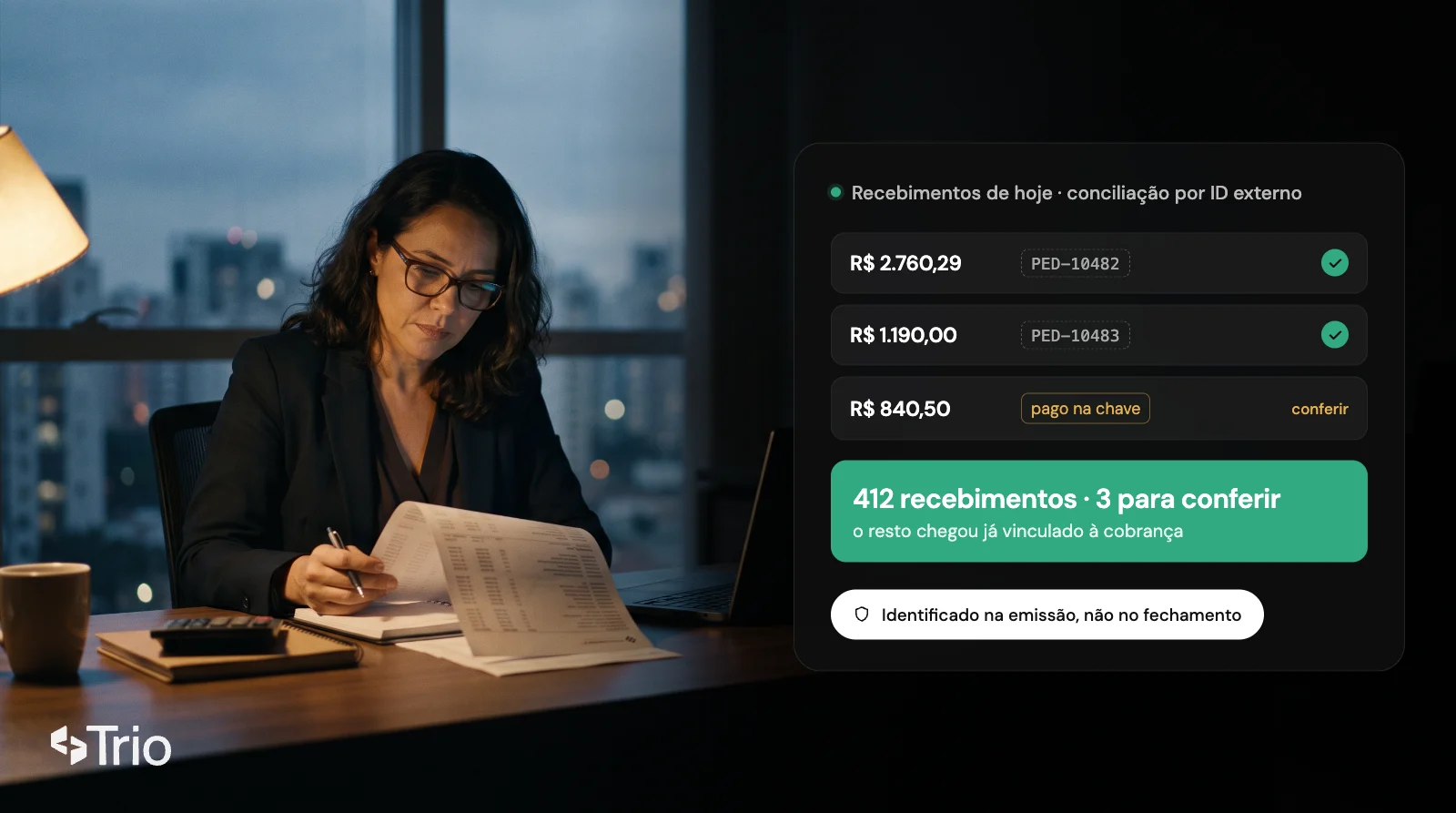
That only works under one condition, and this is where most migrations fail: the charge has to be born carrying the identifier the company’s system already uses for that order or contract. Without it, the payment arrives fast and arrives anonymous, and reconciliation goes back to matching names and amounts. It is the same principle that organises Pix receivables management as a whole, with or without boleto.
Who still needs boleto
This section exists because the honest answer to “should I migrate everything?” is no. There are cases where boleto is not inertia, it is a requirement.
- Customers who pay through an internal accounts-payable process. Many companies only pay what enters their system as a document with a barcode and a due date. It is not a preference, it is an approval flow.
- Public bodies and state-owned companies. Their commitment and settlement procedures usually require a document with a due date and a receipt in the form a boleto provides.
- Debt that may need to be protested. Boleto has an established legal collection path that Pix does not yet replicate.
- Customers with no digital account or no QR code habit. They exist, mostly at high ticket and in older profiles, and forcing the migration costs arrears.
- Charges with a distant due date. A boleto issued for ninety days out is an instrument the payer files away. A QR code works too, but the market still expects a boleto.
A regional distributor with 600 retailers in its book found this out in practice: it moved 70% of the base to Pix in two months, and the remaining 30% took almost a year, because they depended on their own customers’ accounts-payable process, not on the distributor’s will.
The most common mistake is changing the method and keeping the problem
The mistake that shows up most is not in choosing the instrument. It is migrating the payment method without migrating the identifier.
The company swaps boleto for a QR code, celebrates settlement in seconds and, at month-end, finds reconciliation is still manual. The reason is that the new charge was created the same way as the old one: with an amount and a due date, and no order number inside it.
Migrating without that trades a timing problem for an attribution problem. Before, the company was slow to learn who had paid. After, it learns instantly that someone paid, without knowing who.
The question that avoids this mistake comes before choosing the instrument: when this money lands in the account, what exactly will say which charge it belongs to?
The hybrid charge changes the question in February 2027
From 1 February 2027, a single charge will be able to offer both a barcode and a Pix QR code on the same document, with one route cancelled when the other is paid. The rule was published by the Central Bank in September 2026.
That changes the problem statement. Today the company picks, customer by customer, which instrument to send, and carries the risk of picking wrong. From February 2027 it can send both and let the payer choose, with no risk of double payment.
For anyone planning a migration now, the practical consequence is one of sequence. It is not worth waiting for February 2027 to start, because the hard work, putting an identifier on the charge and fixing reconciliation, is the same in either scenario. It is worth avoiding heavy investment in convincing customers to abandon boleto, because before long they will not have to.
| Instrument | Settlement | Identifier per charge | When it makes sense |
|---|---|---|---|
| Boleto | Next business day, in batches | Bank reference, via return file | The customer’s accounts payable, protest, long due dates |
| Pix Cobrança with a due date | Seconds, 24 hours | Unique, with interest and penalty rules | Invoices and fees with a term |
| Pix Automático | Seconds, on the due date | Unique per cycle | Recurring, authorised once |
| Hybrid charge (Feb 2027) | Depends on the route chosen | Unique, on both routes | A mixed book, without forcing migration |
Five steps to migrate without breaking the base
- Split the book by reason, not by size. Those who use boleto out of habit, those who use it because their accounts payable demands it and those who use it for lack of a digital account are three groups that move at different speeds. Mixing the three into one plan is what stalls migrations.
- Start with the group that pays out of habit. It is the largest and the cheapest to move. Sending the new charge alongside the old boleto for two cycles usually settles it without friction.
- Put the identifier in before changing the instrument. If your current charge does not already carry the order number, fixing that first makes the migration pay off in the first month rather than the sixth.
- Measure adoption per group, weekly. The share of charges paid through the new route, by group. Without that number there is no way to tell whether the migration stalled or is merely slow.
- Decide what happens to those who do not migrate. At some point the company decides whether it keeps boleto forever, charges for the old route, or lives with both. That decision needs an owner and a deadline, or the book keeps two processes for good.
Frequently asked questions
Can you bill by Pix with a due date?
Yes. The Pix Cobrança modality with a due date lets you issue a charge dated in the future, with interest and penalty rules applied after it falls due, the same way a boleto does. It is that modality, not the Pix key, that replaces boleto for billing with a term.
Does migrating to Pix reduce arrears?
Not on its own. Pix reduces payment friction and shortens settlement, which helps with lateness caused by forgetfulness or convenience. It changes nothing about arrears caused by lack of funds, which is the larger share. Expecting arrears to fall from the change of instrument alone leads to disappointment.
Does the customer have to authorise anything?
It depends on the modality. For Pix Cobrança, no: the customer receives the QR code or the link and pays whenever they want, as they would with a boleto. For Pix Automático, yes: they authorise once, and later charges happen without any action from them at each due date.
Can I keep boleto and Pix at the same time?
Yes, and it is the most common scenario during a migration. From February 2027 both will be able to live on the same charge, with a barcode and a QR code on one document and automatic cancellation of the unused route. Until then, they coexist per customer, as two documents.
What happens to the bank’s return file?
It carries on existing for the part of the book that stays on boleto. For the part that migrates, the equivalent is the webhook notification, which tells your system at every status change instead of delivering a batch report at the end of the day. Running both through the transition is normal.
How long does migrating a book take?
The technical part usually takes two to four weeks. Adoption by the base is what sets the real timeline, and it ranges from two months to a year depending on the payer’s profile. Operations whose customers are companies with a structured accounts-payable process sit at the longer end.
What this says about where the market is going
Migrating billing from boleto to Pix is not choosing the more modern method. It is accepting that a book has different segments, and that each one pays the way its own process allows.
Central Bank data shows a boleto that stopped growing in volume and climbed in ticket. That is not an instrument dying, it is an instrument finding the place where it is still better. And the rule taking effect in February 2027, allowing both routes on one charge, confirms that reading: the regulator is not ending boleto, it is no longer forcing the choice.
At Trio we look at this transition from the reconciliation side, because that is where it works or fails. Issuing by Pix is easy. Making the payment come back tied to the charge that created it is what separates a migration that removes work from one that only changes the shape of the work.
To understand the identifier part, which is what decides the outcome, read Pix receivables management. For the full vocabulary, from txid to MED, Everything about Pix covers the terms that come up in any migration conversation.