Handling the Special Refund Mechanism (MED)
The governance and technology behind the new refund process in the Pix system

Learn what to do if your company receives a request through the Special Refund Mechanism (MED, Mecanismo Especial de Devolução): a request to return funds received via Pix, Brazil’s instant payment system, in a case of fraud or operational error.
What is MED?
MED was created by the Central Bank of Brazil (BCB) to improve the odds of recovering funds in Pix transactions involving fraud or operational error. It allows the receiving institution, together with the payer’s institution, to identify the case, temporarily block the funds in the destination account and assess whether a refund is due.
Important:
MED is a mechanism exclusive to Pix, created to make refunds easier in cases of fraud or operational error.
When a company can receive a MED request
As the receiving company, you may be contacted by the payer or by a financial or payment institution when the payer claims to have been the victim of a scam or fraud, or when an operational error is identified in the Pix transaction that meets the regulatory conditions.
For the company, this means receiving a formal request from the receiving institution, or from the payer through their institution, along with the obligation to cooperate in blocking or returning the funds.
What the company should do when notified
These are the basic steps the receiving company should take when it gets a request:
a) Initial review
- Receive the notification from the institution (bank or fintech) that MED has been invoked for a transaction involving your account.
- Identify the transaction in question: date and time, amount, receiving Pix key, payer’s name, and any message the payer has provided (for example, a statement that they were scammed).
- Assess whether there are signs of fraud, operational error or a situation that qualifies for MED, or whether the company simply provided a service or received a legitimate payment. If it is legitimate (service delivered, payment for a product or service), it may not qualify for MED.
b) Blocking or holding the funds
- If the transaction is confirmed to be under MED review, the company’s financial institution must block or hold the funds (or part of them) in the destination account so they cannot be withdrawn or transferred. The 2025 rule reinforces that the block must happen as soon as possible after notification.
- The company, in turn, must keep cooperating with the institution: do not release the funds and do not transfer them to anyone else until the case is resolved.
c) Providing information and documentation
- The company must provide the institution (or the payer, depending on the channel) with all the information requested: account statement, proof of whether the product or service was delivered, any communication with the payer, and the origin of the payment.
- If the company finds that the payment really was a mistake, it can say so formally so the institution can speed up the process.
d) Review and partial or full refund
- After the review, if fraud or operational error is confirmed (and the case qualifies for MED), the destination institution (the company’s receiving institution) will return all or part of the amount to the payer, depending on the balance available in the company’s or recipient’s account.
- The company can agree to return the funds voluntarily or cooperate with the refund as the institution determines.
- If the funds have already been transferred or withdrawn from the account, only the portion actually available can be returned.
e) Communicating with the payer and staying compliant
- The company should let the payer (or the institution) know that it received the request and is cooperating in line with the procedure.
- It should also keep records of every action (case numbers, communications, statements) for any future audit or inspection by the Central Bank.
How to manage requests well
- Set up a formal channel for MED refund requests (email, internal support).
- Train your team to spot MED requests quickly and to tell cases of fraud or operational error apart from simple “buyer’s remorse” requests or commercial disputes.
- Document every case: notification date, case number, account activity, and the status of the block or refund.
- Cooperate promptly with the institution and allow the temporary block. Acting fast improves the chances of a successful MED.
- Assess whether there are legitimate grounds to contest the request, for example if the payment was owed or the company delivered the service. If so, present the evidence to the institution.
- Review your fraud prevention policies to reduce improper payments that could lead to MED requests.
How it works at Trio
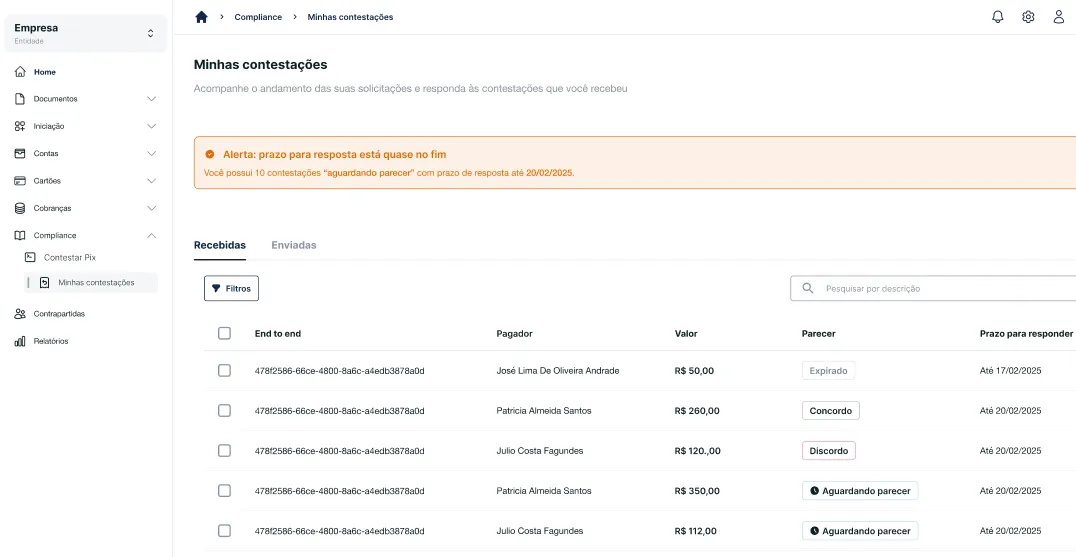
Clients can now manage, request, track and respond to a MED directly in Internet Banking, one transaction at a time or in batches. The feature is available from the Compliance > Contestações (Disputes) menu.
Good to know
MED does not guarantee a 100% refund in every case: it depends on the balance available in the recipient’s account, how quickly everyone acts, and the evidence. Also, transfers sent to the wrong Pix key by mistake and commercial disputes are not covered by MED; in those cases, it is a matter of negotiating directly with the supplier.
The receiving company has the right to defend itself and present proof that the payment was legitimate. It is also essential that the payer notify their institution as soon as they spot the problem: the sooner, the better the chances of success.