MCP for companies: Trio MCP connects AI agents to your corporate account
Trio MCP connects Claude, ChatGPT and other MCP-compatible clients to your company's account at Trio. The agent reads balances, statements, payments, receivables and cards and answers with your operation's numbers. Money movements stay with people.

Trio MCP is Trio’s MCP server. It connects Claude, ChatGPT and other MCP-compatible clients to your company’s corporate account, so an AI agent can read your organization’s balances, statements, payments, receivables, transfers, cards and invoices and answer the finance team with the real numbers from your operation. The tools are read-only: the agent doesn’t move money, and every payment still goes through your Trio account’s approval rules. Agents read, analyze and explain. People approve.
Why AI hasn’t really reached finance yet
Think of a common treasury question at a group with three CNPJs: “how much do we have available right now, across all entities?”. The answer exists, but it’s scattered. Someone opens each account, exports the day’s statement, pastes it into a spreadsheet and adds it up. If the next question is “which payments above R$50,000 went out this week?”, the process starts over.
Many finance teams already use AI assistants to write emails, review contracts or build formulas. What those assistants didn’t have was access to the account data. Without it, AI in finance is stuck in two bad modes: it answers with estimates, or it depends on someone copying and pasting numbers, which brings back exactly the manual work it was supposed to remove.
That’s the starting point for this launch: the bottleneck isn’t the model’s ability, it’s governed access to real data. MCP solves the access part. Governance defines who decides.
What MCP (Model Context Protocol) is
The Model Context Protocol (MCP) is an open standard for connecting AI applications to external systems. Instead of each assistant building its own integration with each system, the system publishes an MCP server with a set of described tools, and any compatible client can use them.
A few milestones help size the standard:
- Anthropic introduced MCP as an open standard in November 2024.
- On December 9, 2025, Anthropic donated the protocol to the Agentic AI Foundation, a Linux Foundation directed fund co-founded by Anthropic, Block and OpenAI, with support from Google, Microsoft, AWS, Cloudflare and Bloomberg.
- On the same date, Anthropic reported more than 10,000 active public MCP servers and adoption in products such as ChatGPT, Gemini, Microsoft Copilot, Cursor and Visual Studio Code.
For a company, the practical consequence is that MCP is no longer a bet on one AI vendor. It has become a common layer between agents and systems, maintained by a neutral foundation. A well-designed MCP server works with the assistant your team already uses.
How Trio MCP works
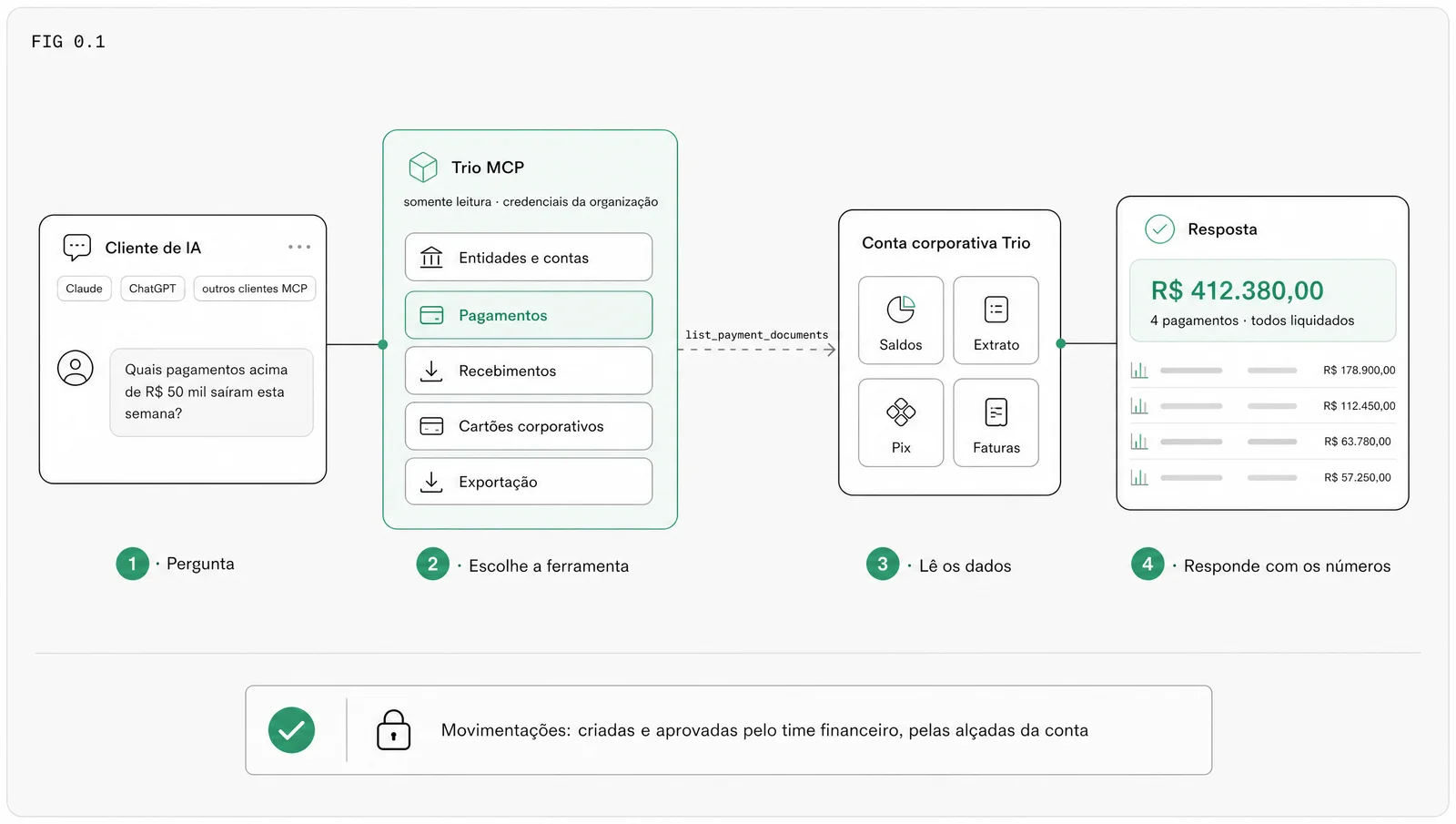
The flow has three parts. The AI client (Claude, ChatGPT or another MCP-compatible client) receives a question from someone on the team. Trio MCP gives the agent 16 read-only tools, each with a description that says when to use it and which one to prefer for a similar question. The Trio corporate account is the source of the data, queried with the credentials that authenticated the session.
The agent picks the right tool, walks through the whole period page by page, and answers with the numbers behind the answer. The 16 tools cover five areas of the operation:
| Area | What the agent can read | Tools |
|---|---|---|
| Entities and accounts | The organization’s CNPJs, accounts with real-time available balance, consolidated statement with running balance, and transfers between accounts | list_entities, list_bank_accounts, get_account_statement, list_bank_account_transfers |
| Payments | Payments sent in a period, lookup by external_id, Pix E2E or platform_id, and payments to a CPF or CNPJ |
list_payment_documents, search_payment_documents, list_payment_documents_by_tax_number |
| Receivables | Pix received and deposits in a period, a receivable with its payer, and receivables from a CPF or CNPJ | list_collecting_documents, search_collecting_documents, list_collecting_documents_by_tax_number |
| Corporate cards | The entity’s prepaid Mastercard cards, purchases in a period, a purchase by E2E, the open invoice and invoice history | list_cards, list_card_purchases, get_card_purchase_by_e2e, get_current_card_invoice, list_card_invoices |
| Export | A temporary link to download an invoice as CSV | export_card_invoice |
The full list, with each tool’s description, is on the Trio MCP page.
Four questions finance can now ask the agent
The examples below are hypothetical and show the kind of question Trio MCP was designed to answer.
The cash position in one question
“What’s the consolidated balance across the group’s entities?” The agent lists the entities, checks each one’s accounts and returns the balance available now, per entity and in total. If the next question is “how much came in and went out today?”, it reads the day’s statement, with inflows, outflows and running balance. The same goes for cash flow, the day’s position and reports for any period.
Any Pix, traced to the end
“Has the Pix with this E2E arrived?” The agent finds the transaction by E2E, external_id or platform_id and shows each step, with who paid or received. You can also ask for everything that went out to a supplier, by CNPJ, or everything that came in from a customer. For accounts receivable, it’s the difference between opening a ticket and answering the customer on the spot.
The card invoice, explained
“What makes up the marketing card’s open invoice?” The agent reads the current invoice, including what’s still pending confirmation, lists the period’s purchases and, if needed, generates a temporary link to download the CSV. The card number always reaches the agent masked.
Checking the period, line by line
“Check this ERP spreadsheet against October’s statement.” With the spreadsheet attached to the conversation, the agent walks through the period’s statement and flags what didn’t match, by each entry’s external_id. It doesn’t replace your system’s bank reconciliation process, but it shortens the investigation of discrepancies.
Agents read, analyze and explain. People approve.
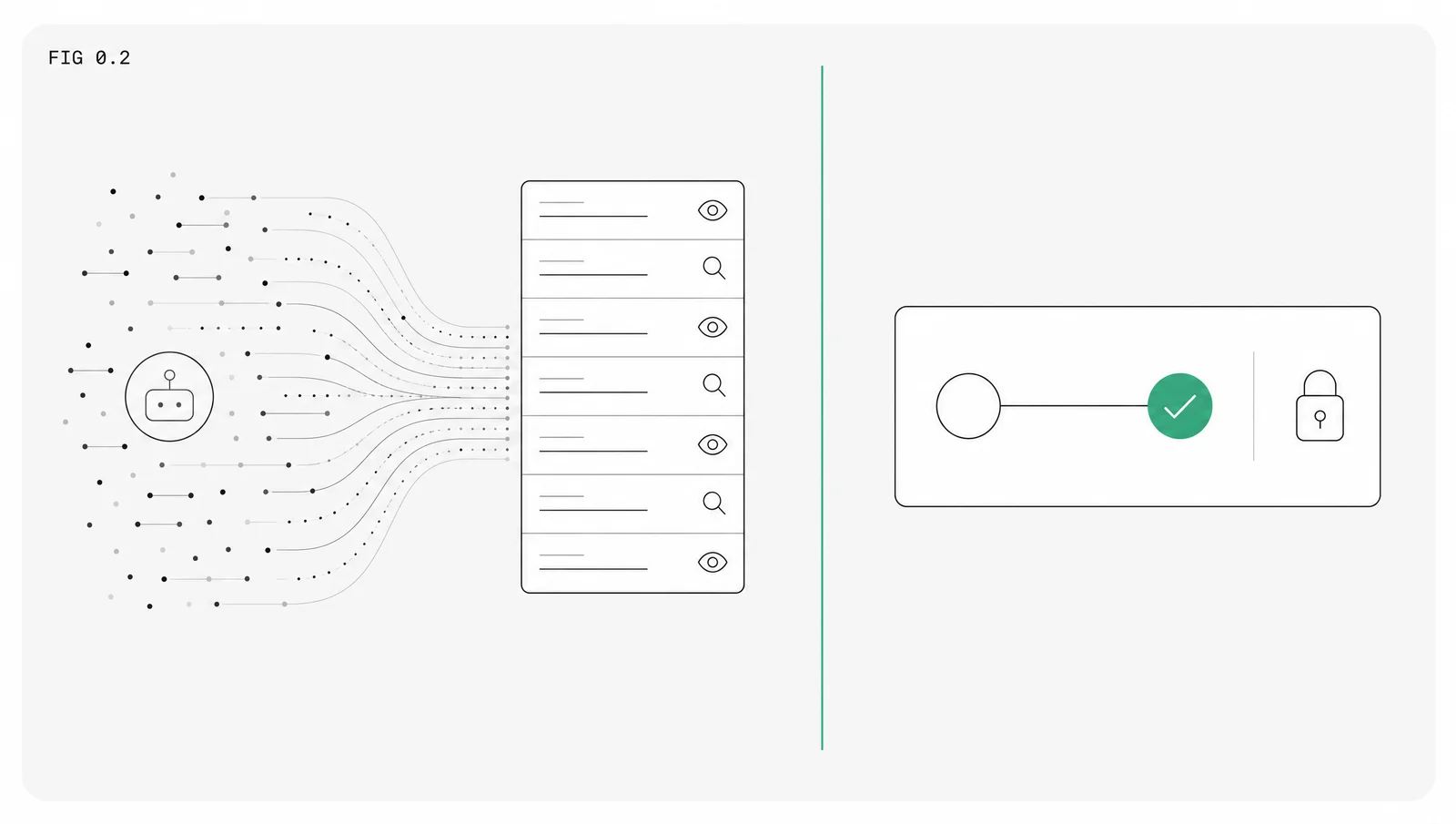
Connecting an AI agent to a bank account only makes sense if the company knows exactly what it can and can’t do. In Trio MCP, that boundary is explicit: delegate the analysis, not the authority.
- Read-only. The tools read balances, statements, transactions, cards and invoices. None of them creates or approves payments. Payments are still created and approved in Trio, through your account’s approval rules.
- Only your organization. Every call runs with the credentials that authenticated the session and is limited to your organization’s data.
- Cards always masked. The agent gets the number as 5555 •••• •••• 4021, never the full number.
- Unambiguous data. Amounts always arrive in cents (R$50,000.00 arrives as
5000000), dates in ISO 8601 and listings paginated withbeforeandaftercursors. The format leaves less room for misreading and makes the agent cover the whole period before answering.
All of this runs on the account’s regulatory foundation: Trio is a Payment Institution authorized by the Banco Central do Brasil (IP 619), has an information security policy under BCB Resolution No. 85/2021, a data protection officer (LGPD) and 99.99% uptime. The details are on the security page and in the article on information security at Trio.
What to check before connecting an agent to the account
An agent with read access to the account is a powerful analysis tool, and that’s why it calls for some care from whoever sets it up:
- Decide who uses it. The data the agent reads is what the session’s credentials can see. Treat access to the agent with the same criteria you apply to access to the account.
- Ask for the evidence, not just the conclusion. The agent shows which tools it called and which numbers it used. For relevant decisions, check the entries behind the answer.
- Be specific about the period and the entity. “Payments above R$50,000 between October 1 and 7, at entity X” gets a better answer than “recent large payments”.
- Keep the approval process as it is. Trio MCP was designed so the decision stays with the team. If an agent suggests a payment, it follows the normal path: created and approved in Trio, by whoever has the authority.
For developers: your own agents on the same API
Trio MCP’s tools follow the conventions of Trio’s API: payment, receivable and transfer documents, external_id and amounts in cents. To go beyond the ready-made tools, your team can build its own agents on the REST API and test everything in the sandbox, with no financial risk.
- API documentation: endpoints, webhooks and conventions, readable by people and by AI agents.
- Sandbox: a complete environment to test the integration.
- Trio for developers: REST API, webhooks, Checkout SDK and the path from design to Go Live.
What changes for finance
Trio MCP doesn’t change who decides in finance. It changes the time between the question and the number. Treasury asks for the cash position and gets the answer per entity. Accounts receivable traces a Pix without opening a ticket. Controllership investigates the period’s discrepancies from the full statement, not a sample. And every answer comes from the account data, with the same governance the company already has.
It’s the same logic that has guided Trio’s platform from the start: a corporate account the finance team operates, developers integrate and, now, AI agents query. To see how AI is changing financial services more broadly, also read AI in financial services and The CFO of the future.
Want to see Trio MCP working with your operation’s data? Talk to Trio and tell us how your team wants to use AI agents. To see all the tools, visit the Trio MCP page.