Corporate prepaid cards in Brazil: how they work, when they fit and what to compare
Three in four prepaid cards issued in Brazil are never activated. What separates the ones that work, in an honest comparison against corporate debit and credit.
The conversation always starts the same way. Someone in finance opens the corporate card invoice on the 5th, finds a R$ 1,890 software subscription nobody recognises, and spends the morning working out who signed up for it, for which project, and whether anyone approved it. By midday the expense is still there, now with an owner and no decision left to make, because the money is already gone.
The cost of that morning never shows up as a line in the results. It shows up in the close that slips, in the allocation done by approximation, and in the spending policy that exists in a document and not in practice. The more teams start spending, the more the monthly invoice turns into an exercise in archaeology.
A corporate prepaid card reverses that order: the company sets the amount before the purchase, and the card declines anything above it. The trade has a real cost on the other side, because the money leaves the cash position at the moment of purchase, without the term a credit card offers. The sections below cover when that trade pays off, when it turns out expensive, and what to ask a vendor before signing.
Three in four prepaid cards issued in Brazil are never used
Banco Central open data shows that in the second quarter of 2026 the country had 271.6 million prepaid cards issued and 68.4 million active. The activation rate came in at 25.2%, down consistently since 2021, when it stood at 38.3%. The figure says more about how the instrument is adopted than any sales material in the category.
The reason behind the abandonment tends to be the same one, and it is worth knowing before you sign. A card handed out without replacing any process depends on somebody remembering it exists at the exact moment of purchase, precisely when the old path is still open and working. The card that sticks is the one that takes the place of a routine the company already wanted gone, usually the expense report, the travel advance, or the founder’s personal card paying for team tools.
Before comparing vendors, it is worth answering which specific expense is going to move. That answer defines the rollout and separates the companies that land in the 25% from the ones padding the other three quarters.
Corporate spending runs at a different scale, and that changes the maths
In the same quarter, the average prepaid card transaction in Brazil was R$ 40.96, a figure pulled down by meal vouchers and consumer cards, which make up most of the base. The Banco Central’s business and corporate card cut shows a different picture: an average transaction of R$ 198.40, with R$ 76.6 billion moved in the quarter and growth of 17.7% in value against the same period a year earlier.
That is nearly five times the consumer prepaid ticket, above even the consumer credit card at R$ 139.31. The gap matters when comparing proposals, because a fee charged per card issued has a small effect on a low ticket and defines the entire design on a high one. That fee decides whether a company creates one card per project or falls back to one card per person.
Choosing between prepaid, debit and credit is a question of when the money leaves
The three instruments solve different problems, and the comparison pays off when it looks at what changes in the finance team’s routine. The table below organises the criteria that usually decide it.
| Criterion | Corporate prepaid | Corporate debit | Corporate credit |
|---|---|---|---|
| Where the money comes from | A balance allocated to the card | The account balance, directly | A limit granted by the issuer |
| When it leaves the cash position | At purchase | At purchase | At invoice due date |
| Credit check | Not required | Not required | Required, with a credit bureau |
| If an employee overspends | The purchase is declined for insufficient balance | Eats into the account’s operating balance | Consumes the company’s shared limit |
| Term to pay | None | None | 30 to 40 days, by cycle |
| What reaches reconciliation | Transaction already tied to the card and cost centre | A line on the account statement | A consolidated invoice, split later |
| Issuing one more card | Immediate, no limit to grant | Depends on the bank | Depends on analysis |
The row that changes daily life most is the one about overspending. With prepaid, control happens before the purchase and the decline appears at the merchant’s terminal, while with corporate credit control arrives afterwards, with the expense already made and somebody deciding what to do about it in the closing meeting.
Translated into the routine of whoever accounts for the spend, the difference shows up the following month. With expense reports, the cost enters the system days after it happened and classified by whoever remembers; with a consolidated invoice, somebody splits it line by line at month end. When there is a card per cost centre, the classification already happened at issuance, and the question of which area the expense belongs to simply stops being asked.
When prepaid is the wrong call
This is the section comparisons in this market usually leave out, and the omission is understandable, because no vendor enjoys listing where its own product loses. It is here because the wrong choice is expensive, and in four recognisable situations prepaid is the weaker option.
The first is the company that needs the term. Corporate credit gives 30 to 40 days between the purchase and the outflow, and that interval works as working capital for anyone running tight on cash. A company spending R$ 200,000 a month on cards that moves to prepaid pulls that entire amount forward, every month, from the switch onward. The trade can be worth it for the control, and it is a calculation to run before deciding.
The second involves unpredictable, urgent spending. When an expense appears without warning and has to be paid immediately, allocating a balance in advance becomes friction, because somebody has to release the amount. There is a way around it, keeping a generous balance on each card, except that it undoes part of the control that motivated the move.
The third is the company whose decision runs through points and miles, an economy that belongs to the credit card and that prepaid does not match. The fourth is the most common of all, the same one behind those three in four abandoned cards: somebody has to decide balance, period and holder every cycle, and without a named owner the company simply swaps one manual process for another.
Three decisions before handing out the first card
- Pick the expense, not the team. List the three expenses that generate the most reimbursement or most delay your close, and create the first card to remove one of them, because adoption is proven on a specific expense rather than in a company-wide announcement.
- Agree who tops up, and how fast. This is where rollouts usually stall: if the answer is to open a ticket and wait, the team goes back to personal cards on the first urgent purchase.
- Close the old path. While expense reports are still accepted in parallel, part of the team keeps using the process it knows, and the replacement never completes.
In the vendor conversation, three questions separate proposals better than a price table: what it costs to issue each card, whether unused balance returns to the account, and whether the transaction arrives reconciled with the main account. The first defines the design, the second defines how much working capital sits idle, and the third defines whether the close stays manual.
Where Trio fits
Controlling corporate spend is less about the card and more about the order of decisions: who sets the amount, when the money leaves, and what arrives classified. An instrument that answers all three at the source gives the finance team back the time that goes into invoice archaeology.
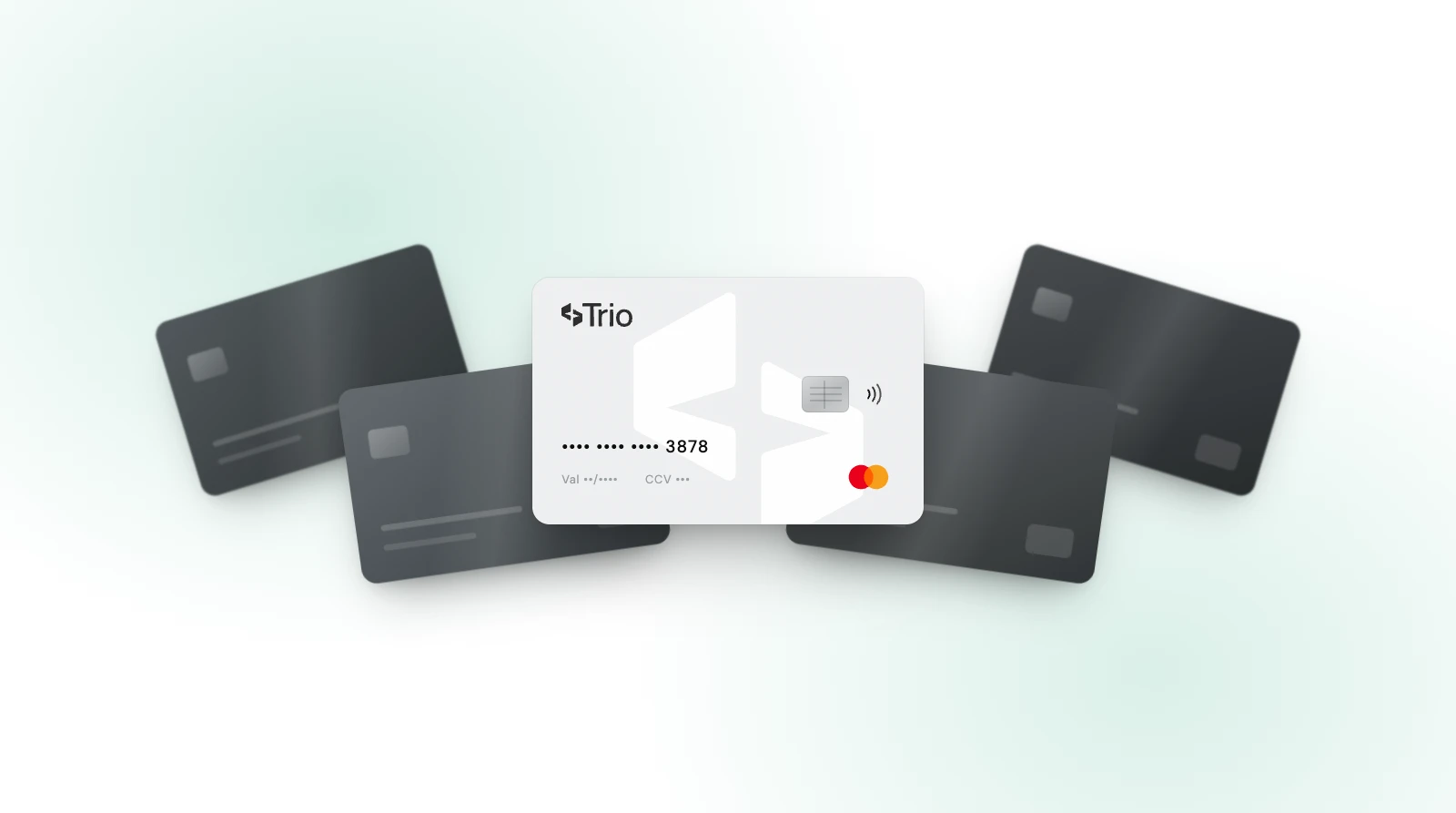
Trio issues a Mastercard corporate prepaid card, virtual and unlimited, straight from the corporate account. There is no credit check, because there is no credit to grant, and there is no fee per card issued, which turns creating one card per area into an organisational decision. Unused balance stays in the corporate account and can be returned or moved between cards, and every transaction arrives tied to the main account, separated by cost centre.
One limit worth stating: Trio does not issue physical cards. If your operation depends on in-person spending with plastic, that restriction belongs in the comparison from the start.
The cards page shows cost-centre control and reconciliation working, with the product screens. To discuss how a rollout would look in your operation, talk to a specialist.